Top Food Blogs

Friday, 12 November 2010

KK's Fried Chicken

European cuisine, or alternatively Western cuisine, is a generalized term collectively referring to the cuisines of Europe and other Western countries. European cuisine or Western cuisine includes that of Europe including (depending on the definition) that of Russia, as well as non-indigenous cuisines of North America, Australia and Latin America, which derive substantial influence from European settlers in those regions. The term  Continental Cuisine is used by East Asians to contrast with Asian styles of cooking. (This is analogous to Westerners referring collectively to the cuisines of East Asian countries as Asian cuisine.) When used by Westerners, the term may sometimes refer more specifically to cuisine in Europe or continental; in this context, a synonym is Continental Cuisine, especially in British English.
The cuisines of Western countries are diverse by themselves, although there are common characteristics that distinguishes Western cooking from cuisines of Asian countries and others. Compared with traditional cooking of Asian countries, for example, meat is more prominent and substantial in serving-size. Steak in particular is a common dish across the West. Similarly to some Asian cuisines, Western cuisines also put substantial emphasis on sauces as  seasonings, or accompaniments  Wheat-flour bread has long been the most common sources of starch in this cuisine, along with pasta maccaroni ar noodles.  and some times potato plays a major starch plant in the diet of Europeans in the form of bloied (mashed potato) or deep fried (french fries) Generally the term refers to European cooking, or more specifically non-English European cooking.

A style of cooking that includes some authentic dishes of various western-Europian countries. as a whole it could be considered as international cuisine paticularly Bristish, American, Australian, NewZealand. it can be shortly categorised by it's way of cooking which involves bakes, grills, stews, barbeques, deepfry, saute'. Today Continental Cuisine has probably come to mean a blend of all international cuisines.

Continental Cuisine is known for its elegant cooking style and also for its beautiful presentation. In terms of health and calories Continental Cuisine is generally good beacuse of its easy digestibility and use of fresh herbs which makes it less spicy but tasty. Generally a typical Continental Lunch or dinner is served in foru courses viz a salad, soup accompanied by a variety of breads/buns, a main course of meat or fish items (in sumptuous quantity) that is baked, grilled or fried and  served with boiled vegetables or mashed potato/ french fries and ends with a pudding for dessert.

 Krishnokoli's Kitchen has already had some interesting Continental Dishes of its own like Pizza, "fish & chips", Pie, Bread-de-lite, Chessy Garlic toast and soups, Puddings. Today I will post a typical Continental dinner from my kitchen. A standard ChickenSsoup, a Salad, KK Fried Chicken along with Garlic Bread and discuss the recipe of the authentic Fried Chicken cooked by me. Hope you will enjoy this simple mouthwatering recipe!


KK'S FRIED CHICKEN
ingredients4KK
  • Chicken Leg or Breast Pieces ( thoroughly cleaned in running water)
  • Lemon juice
  • Salt,
  • Red Pepper Powder
  • White & Black Pepper Powder
  • Ginger, Garlic & Green Chilly Paste 
  • Egg White & and a little Flour
  • Bread Crumb or Corn Flakes Powder
  • Refined Oil for deep frying
Photobucket 
  • Marinate Chicken Pieces(4 pcs) with 1/2 tsp lemon juice, salt, pepper and 2 tsp Ginger-garlic-green Chilly paste for at least 6 hours and keep in the refrigerator( do not put them into deep fridge)
  • Add the egg white and 1 tsp flour.
  • Coat each chicken piece substaintially  with the crumb
  • Deep Fry the Chicken Pieces in refined oil for 15 minutes( to ensure complete cooking) till it becomes golden yellow in colour.
  • Serve hot with Soup/ Salad/ French Fries 
   Page copy protected against web site content infringement by Copyscape

Thursday, 28 October 2010

Smoked Hilsa, as it is there in Telegraph Magazine GRAPHITI, October24, 2010

Few months ago i posted a recipe of SORSE EELISH as its is cooked in my house. On of my bolgger friends UshnishDa asked for the recipe of SMOKED HILSA. I have tasted smoked hilsa in ITC Sonar, Kolkata last year but i did not have the idea to cook. Fortunately i have seen this recipe as it is published in the food column of The Telegraph Sunday Magazine GRAPHITI (dated 24th October, 2010)  written by Rahul Verma. The Chef Mayank Kulshreshtha of ITC Sonar shared this authentic recipe of smoked hilsa with food journalist Rahul Verma of Graphiti.
I am sharing this recipe as it is told to Rahul Verma by the chef.

Steps:
  •  Fillet the Hilsa Fish
  • Marinate with Kasundi(Mustard Paste), a smoked hickory flavoured liquor available in some stores, salt, pepper, lemon juice, mustard oil and some tabasco sauce.
  • Leave the marinated fillet overnight in a cool place.
  • Smoke it in a pan in a smoking chamber and debone.
  • The sauce is prepared by reducing the liquid left in the pan with tomato juice.
  • Serve the smoked hilsa with a salad of Arugula leaves tossed in extra virgin olive oil and the smoked sauce.

Hope my Blogger friend Ushnish Da will like it!!!

Tuesday, 26 October 2010

Becti Tef-flora (Bhetki paturi)


Ingredients:
  • Becti fish, cut into 4 in. x 4 in. thick fillets
  • Pui leaves or any other edible greens, excluding spinach (too soft!)
  • KK's Green-fish paste : made by coarsely pasted mustard, ginger, garlic, green chillies, coriander leaves, and a few spring onions.
  • Salt, a pinch of turmeric powder, lemon juice
  • Mustard oil for shallow frying
Procedure:

  • Marinate the Becti fillets with salt, turmeric powder, lemon juice, and the KK's special green-fish paste for at least two hours.
  • Take a wide-non stick (teflon coated) skillet, and grease it with 1 tsp mustard oil to allow seasoning.
  • Place each of the marinated becti fillet inside a green leaf (preferably Pui leaf), brush it with 1/2 tsp mustard oil, and fold the leaf in a triangular fashion (much like a betel leaf). Ensure that the leaf doesn't open up by pricking through the folds with wooden toothpick (plastic ones may melt). Place these folded fish fillets, four at a time, on the non stick skillet. Apply high heat initially, and then shallow-fry over a low flame. Turn over when the lower face is cooked. Ensure that the interior gets fully cooked WITHOUT the green colour fading away.
  • Serve with hot rice and mustard.
Note that the green leaf used here is edible, and so it can be consumed along with the fish unlike the paturi. Moreover the masala-tang, and the taste of the fish, along with the nutritional value is entirely preserved.

Monday, 11 October 2010

Sharodiya Durga Puja Wishes For All Friends of Krishnokoleer Kitchen !!!


 সকলকে জানাই কৃষ্ণকলির রান্নাঘর থেকে শারদীয়ার প্রীতি ও শুভেচ্ছা 


  Durga Puja Special Menu  
Maha-Shosthi
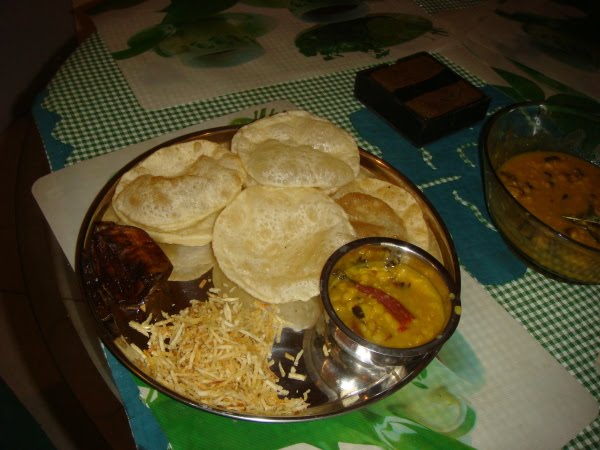
Luchi
Cholar Dal
Begun Bhaja
Alu Bhaja

    Maha-Saptami


     Maha-Astami
    Mayer Bhog
    Khichuri
    Bhaja
    Chachhori
    Chutney
    Papad
    Payesh

    Maha-Navami
    Plain Rice


     Maha-Dashomi
    Raita


    Everyday the puja lunch will be accompanied with Relish or Chutney at the end !
    and of course with a sweet dish like Payesh / Pithe


    Enjoy This Puja With Your Friends And Family And Have Good Food Everyday!!!
    For Your Gastronomic Satisfaction Enjoy The Recipe From Krishnokolee's Kitchen !!!

    শুভ্রশঙ্খরবে সারা নিখিল ধ্বনিত আকাশপুরে অনিলে জলে দিকে দিগঞ্চলে সকল লোকের পুরে বনান্তরে নৃত্যগীত ছন্দে মন্দ্রিত 

    Wednesday, 29 September 2010

    Chilly Cheese Uttapam ... simply AWESOME !

     
    Whenever I go to the BIG BAZAR at Kharagpur we somehow end up having  "Chilly Cheese Uttapam" . It's simply GREAT! If you happen to be in the neighbourhood do not miss this  CCU @ Big Bazar, Food Court.

    Last night I decided to make it at home, in my kitchen. Though I did not have the time or the energy to make sambar, the coconut chutney more than made up for it when I served it with the crispy mout;watering uttapam.  Unfortunately I do not have a grinder-mixer in our bungalow Kharagpur  (where my husband is a professor at the School of Management at IIT ) so i had to ask my maid to paste it using a SHIL-NORI.
    Do you remember the famous song? "Shil-Nori bina chutney kaise boni ?"   Anyway enough by way of prelude; time for the real stuff ... for which you need the following ingredients to make this CCU
    • 2 Cups of rice flour and 1 Cup urad dal powder, soaked in water for over night and mixed well to make a thick batter.
    • pinch of salt
    • One large onion (finely chopped)
    • Green Chillies ( finely chopped)
    • Cheese (grated)
    • Refined oil
    Heat a nonstick pan , grease it with refined oil and place1 tablespoon  thick  batter. Spread it with a spatula. Then sprinkle onion, chillies on top.Turn upside down and add grated cheese on the hot side of the uttapam. Keep it on the nonstick tawa till it becomes crispy and the cheese melts.

    Serve hot with coconut chutney.


           Page copy protected against web site content infringement by Copyscape

    Saturday, 11 September 2010

    CHUTNEY : A unique Bengali Relish

    Traditional PLASTIC CHUTNEY without turmeric powder


    CHUTNEY is one of the most important BENGALEE dishes generally served after the main course along with papad, but before the dessert. During Summer it is advisable, if not really pleasant :-) to have the chutney at the end of all meals. This is not only because of the chutney's food value but also it's fruit value ! Fruits after all are always good because they carry  lots of vitamins. Moreover in summer, we tend to lose a lot of fluids in profuse sweating and quite a bit of this is said to be replenished with chutney.

    Unfortunately in this age of diet consciousness, a chutney is beyond doubt a HIGH CALORIE dish. But if you do not have bloodsugar and generally lead a reasonably active life, then you can safely have a modest portion of  chutney every alternate day at the end of your lunch without feeling too guilty about it !

    All said and done, a chutney is a nice relish to end your meal with.

    Basic Ingredients of CHUTNEY is SUGAR, SUGAR and SUGAR, (if you are diabetic, or counting calories you can use sugar-free of course), a little salt and something sour(like lemon juice or tamarind juice).

    Making a chutney is simple. You first cook the fruit or vegetable in the sugar syrup. Then you can thicken the chutney at the end by adding cornflour or maida. Addition of  CHAUNK and turmeric powder is optional.

    FRUITS that can be used to make chutney:
    • Raw Mango
    • Pineapple
    • Apple
    • Grapes
    • Date Palm
    • Raisins
    • Amawat (Dehydrated Mango pulp)
    • Pomegranate
    • Alubakara ( Plum)
    • Cherry
    • Green Olive 
    • Strawberry
    VEGETABLES used in chutney
    • Green Papaya
    • Gourd 
    • Tomato
    • Corriandar leaves/Mint leaves


    Page copy protected against web site content infringement by Copyscape

    Wednesday, 1 September 2010

    CRISPY BABY CORNS


    Fresh Baby Corns as available in any Supermarkets


    Ingredients:
    Fresh Baby Corns
    Corn Flour
    Flour
    Soya Sauce
    Tomato Ketchup
     Salt
     Refined Oil 
    Garlic& Ginger (Greated): 2tsp each
     Procedure:
     Clean & Cut the baby corns into small pieces(2 to 3 inches) and marinate with soyasauce, salt and a little sugar. Meanwhile fry the ginger & garlic in 2 tsp refined oil and keep aside. Sprinkle a little cornflour and a little flour over the marinated babycorns. Now make a batter by adding 4tbsp cornflour& and 2tbsp flour in icecold water and deep fry the marinated babycorns by coating them into the batter. Use a low flame to avoid over frying. Toss the crisp-fried babycorns with the fried ginger-garlic and 2 tsp tomato ketchup and serve hot.